What Is Powder Apple Cider Vinegar and How Does It Work?
Powder Apple Cider Vinegar is a dried form of apple cider vinegar designed for convenient use. It usually begins as liquid vinegar, then undergoes drying with a carrier ingredient. The result is a fine powder that can be mixed into capsules, drink sachets, or functional foods. It is not simply ground-up apples. Its effects depend on the remaining acetic acid and the product’s manufacturing method.
Carol Johnston, PhD, a leading vinegar researcher at Arizona State University, has cautioned, “Vinegar is not a magic bullet.” That warning matters here. Research on vinegar has mainly examined liquid products, not every Powder Apple Cider Vinegar supplement. Powder formulas may differ in acidity, serving size, and added ingredients. Read the label carefully.
The proposed mechanism is fairly simple. Acetic acid may slow stomach emptying and influence carbohydrate digestion. These effects could modestly affect post-meal blood glucose in some adults. The word is modestly. It is not a treatment for diabetes, obesity, or digestive disease. Some users may experience throat irritation, nausea, or stomach discomfort. Products with sweeteners or concentrated acids require extra attention.
A practical detail is often overlooked. Mixability does not prove effectiveness. A powder may dissolve quickly but contain little acetic acid. I also think the evidence remains uneven, especially for long-term use. People taking glucose-lowering medicine, or those with reflux, should ask a qualified healthcare professional before trying it. This article will examine how Powder Apple Cider Vinegar is made, how it may work, and where its claims become less certain.
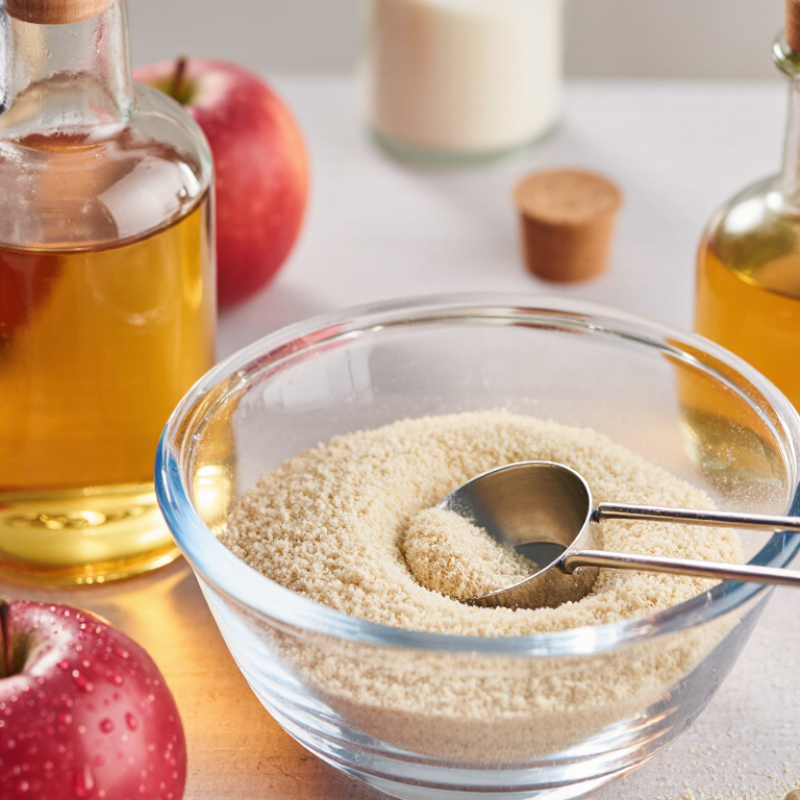
What Powder Apple Cider Vinegar Is: Dehydrated Vinegar and Carrier Solids
Powder apple cider vinegar is not simply liquid vinegar with the water removed. It is usually dehydrated through spray drying, then blended with carrier solids such as maltodextrin, acacia fiber, or starch. These materials help protect volatile acids, reduce stickiness, and create a free-flowing powder. The process is practical, but the carrier can form a meaningful share of the scoop.
According to MarketsandMarkets’ 2024 Spray Drying Equipment Market report, the global market was valued at about USD 5.2 billion in 2024 and is projected to grow steadily through 2029. That growth reflects demand for stable powders in food and nutrition manufacturing. It does not prove that every vinegar powder preserves the same acidity as liquid vinegar. A careful label review still matters.
The powder works after moisture meets it again. Acetic acid dissolves, while the carrier solids disperse through the drink or food. Many products provide only a small amount of acetic acid per serving. Grand View Research’s 2024 Dietary Supplements Market report estimated the global market at USD 177.5 billion in 2023, showing why convenient formats attract attention. Convenience can hide complexity. Powder weight is not equal to vinegar strength. Processing heat, storage humidity, particle size, and packaging can all affect performance. In my view, this is where product claims need more restraint.
What Is Powder Apple Cider Vinegar and How Does It Work?
Powder apple cider vinegar is dehydrated vinegar combined with carrier solids that help create a stable, free-flowing powder. Dehydration removes most of the water, while the acetic acid and other dissolved vinegar components remain in the dried material. The final acetic-acid concentration depends on the formulation and serving size.
How It Is Made: Spray-Drying and the FDA’s ≥4 g/100 mL Acidity Standard
Powder apple cider vinegar begins as liquid vinegar, not a different fruit ingredient. During spray-drying, the liquid is atomized into warm air. Water evaporates quickly, leaving fine particles. A carrier, such as a soluble fiber, may protect the acids and improve flow. The process resembles a mist becoming dust.
The important measure is acidity. In the United States, FDA identity rules for vinegar specify at least 4 grams of acetic acid per 100 milliliters. This standard applies to vinegar as a liquid. It does not automatically prove that every powder serving has identical acidity. Powder products must be evaluated after reconstitution, using their stated water volume and laboratory testing. Small changes matter. Too little water can make the drink taste sharply sour and misrepresent the intended concentration. Too much water weakens it. I would not treat “vinegar powder” as a complete explanation of potency.
Tips: Check the ingredient list and serving directions. Look for declared acetic acid content, if provided. Reconstitute the powder exactly as instructed. A kitchen spoon cannot confirm acidity. Packaging should also identify moisture protection, because humidity can cause clumping and gradual quality loss. If the label gives only a vague “equivalent” amount, ask how that number was measured. It may be useful, but it is not the same as verified acidity.
Acetic Acid Delivery: Converting Liquid Vinegar Doses into Powder Equivalents
What Is Powder Apple Cider Vinegar and How Does It Work?
Acetic Acid Delivery: Converting Liquid Vinegar Doses into Powder Equivalents
Powder apple cider vinegar is not simply dried liquid vinegar. Manufacturers usually spray-dry vinegar onto a carrier, creating a lighter, more stable ingredient. The key compound remains acetic acid, but its concentration varies between products. The U.S. Food and Drug Administration recognizes vinegar containing at least 4 grams of acetic acid per 100 milliliters. Many eating vinegars contain about 5%, according to food chemistry references. Therefore, 15 milliliters of 5% vinegar provides approximately 0.75 grams of acetic acid.
Powder calculations require the product’s assay, not just its serving size. If a powder contains 35% acetic acid, 0.75 grams requires about 2.1 grams of powder. That estimate changes with moisture, carrier material, and manufacturing losses. It is not universal. A label showing “500 milligrams vinegar powder” may not equal 500 milligrams of acetic acid. This is where consumers and writers often oversimplify the numbers.
Tips: Check the acetic acid percentage, serving weight, and carrier ingredients. Use a digital scale for repeatable measurements. Do not assume one capsule equals one tablespoon of liquid vinegar. The Codex food standard also treats acidity as a defining quality measure, supporting careful label comparison. In practice, powder can mix smoothly into water, but its taste and acidity may feel weaker. My own calculation would still need the batch specification. Conversions look precise. They are not always precise.
How It May Work: Gastric Emptying, AMPK Signaling, and Glucose Response
Powder apple cider vinegar is dehydrated vinegar blended into a dry, measurable form. It may provide acetic acid, the compound most often studied in liquid vinegar. However, powder products can differ in acidity, processing, and absorption. The label matters more than the word “vinegar.”
Its possible effect may begin in the stomach. Acetic acid could slow gastric emptying in some people, allowing food to enter the small intestine more gradually. That delay may soften the rise in blood glucose after a carbohydrate-rich meal. The effect is not guaranteed. Meal size, fiber, exercise, and individual digestion can change the response.
Researchers also discuss AMPK signaling, a cellular pathway linked with energy balance. In laboratory studies, acetic acid may influence this pathway and fat metabolism. Human evidence remains smaller and less consistent. That gap matters. A mechanism seen in cells does not automatically produce a strong effect in people.
A careful trial is more useful than a confident promise. Some people may notice steadier readings after meals. Others may notice nothing. Glucose monitoring, when medically appropriate, can show individual responses more clearly than assumptions. Powder should be mixed as directed, because concentrated acidity may irritate the throat, stomach, or teeth. People using glucose-lowering medicine should ask a qualified clinician before regular use. The science is interesting, but still incomplete.
Safety and Quality: NIH Evidence, Label Accuracy, and Daily Exposure Limits
Powder apple cider vinegar is usually made by drying liquid vinegar onto a carrier powder. After mixing with water, it may provide acetic acid, the compound linked to vinegar’s sour taste and some studied effects. However, the powder is not automatically equivalent to liquid vinegar. Processing methods, moisture, and serving size can change its strength.
Safety deserves more attention than marketing claims. NIH-supported evidence on apple cider vinegar remains limited, and there is no universally accepted NIH daily exposure limit for vinegar powder. A label should state the acetic acid amount, serving size, added carriers, allergens, and testing methods. “Equivalent to vinegar” is too vague without measurable details. Independent laboratory testing can support label accuracy, but testing claims still need verification.
Start with the smallest labeled serving and mix it fully with water. Never swallow concentrated powder dry. Repeated acid exposure may irritate the throat, stomach, or tooth enamel. Rinsing the mouth with water afterward may reduce dental contact, though it does not remove every risk. People using insulin, diuretics, or medicines affected by potassium should ask a clinician before regular use. This is where my confidence becomes cautious: powder products are less standardized than many consumers assume. A clean label helps, but it cannot replace clinical judgment or careful monitoring.


